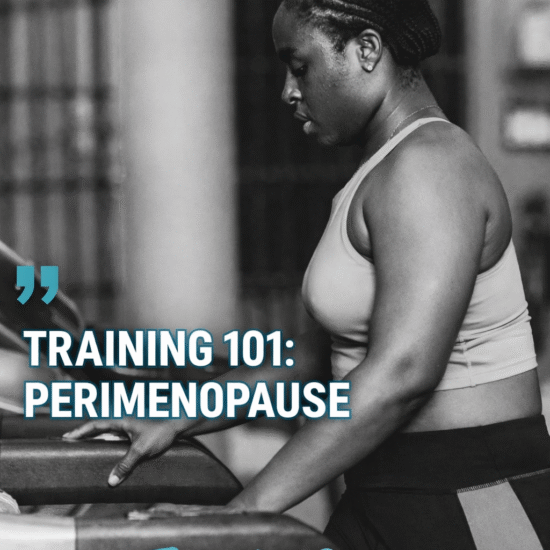
Training in Perimenopause: How to Lift, Sprint, Recover, and Keep Your Momentum
Hormones may feel unpredictable. Your plan doesn’t have to be.
If you’re in perimenopause and you’re already consistent with training (moderate to high activity),
the goal isn’t to do “more.” The goal is to train smarter—optimize stress, protect lean mass,
build power, support metabolism, and keep you feeling like you.
First—what’s happening in perimenopause?
Perimenopause is the transition phase where estrogen and progesterone can fluctuate (sometimes wildly).
That’s why you might feel strong and unstoppable one week… then flat, foggy, or inflamed the next.
It’s not “you falling off.” It’s physiology. And we train with it—not against it.
The TWC approach: 5 training priorities for perimenopause
1) Consistency is the anchor
Your hormones can be unpredictable, but your training shouldn’t be. Put your workouts on your calendar like a
non-negotiable wellness meeting. If you feel “off” on a day you planned hard work, don’t quit—pivot:
technique work, a shorter sprint set instead of a longer HIIT session, or a simple walk outside.
2) Lift heavy (with coaching-level form)
Compound lifts (deadlifts, squats, presses, rows) are your best friends here. Think
3–6 reps for 2–4 sets to protect lean mass and bone density. Add
tempo (changing the speed of the lift) to build power without wrecking your recovery.
TWC coach note: Learning to lift heavy well can take 6–12 months. That’s normal.
We never trade form for load. We earn strength.
3) Add SIT or HIIT 1–2x/week (short, hard, effective)
Short, hard efforts can drive vascular, mitochondrial, and metabolic adaptation—and they can help mood and brain health.
Keep it strategic: a little intensity goes a long way.
- SIT example: 6–10 rounds of 10–20 seconds hard + 60–90 seconds easy
- HIIT example: 6–10 rounds of 30 seconds hard + 90 seconds easy
4) Impact work matters for bone
Bone responds to impact and multidirectional loading. That can be simple jumps, hops, low-level plyos, or quick
“micro-doses” that take 2–5 minutes a day. If impact is new to you, we progress it intentionally.
5) Get back in your groove (brain fog + low mood are real)
Low motivation, mood swings, and brain fog can show up. When that happens, we don’t shame it—we shift the strategy:
make training more social, try a new class, change the environment, or chase a fresh performance goal.
Momentum counts.
Your perimenopause training goals (TWC focus)
- Improve strength + muscular power
- Protect lean mass + bone density
- Include smart intensity (not endless grind)
- Stabilize metabolism
- Support recovery so you can stay consistent
A simple weekly template you can follow
Here’s a clean starting point for active women in perimenopause. Adjust based on sleep, stress, and recovery.
Ready to train with a plan built for this season?
If you want structure, progressive strength, and coaching that matches what your body needs right now,
I’ve got you. Let’s build your Strong.
Train With Cain • Stronger Together as WON